
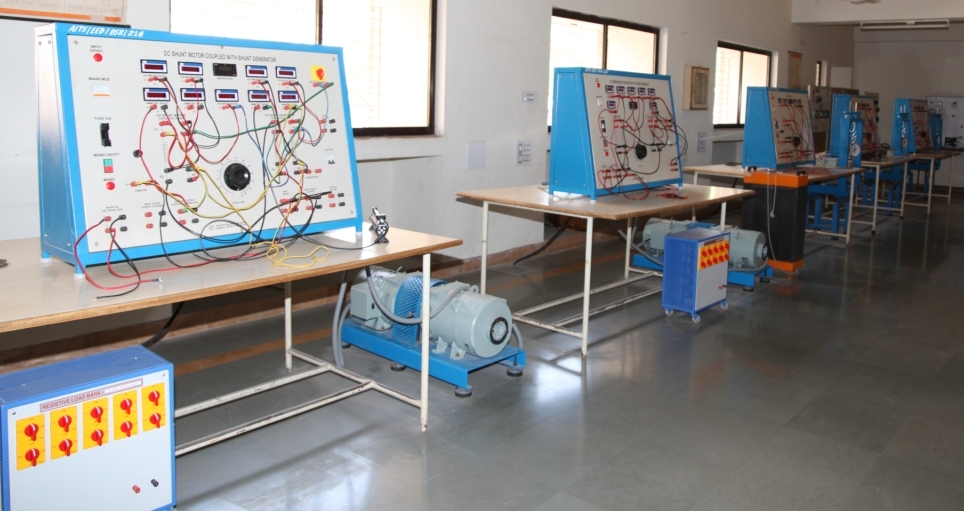
BASIC ELECTRICAL LAB
BASIC ELECTRICAL LAB EXP SETUP
The Basic Electrical Technology Lab Equipment Suite is a comprehensive educational and practical training solution designed for engineering colleges, polytechnic institutes, ITI centers, vocational training laboratories, and technical universities. This integrated laboratory setup enables students and trainees to perform a wide range of fundamental and advanced electrical engineering experiments related to circuit theory, electrical machines, power measurement, transformers, motor control, resonance circuits, and instrumentation.
The laboratory equipment is manufactured using high-quality industrial-grade components and is mounted on ergonomically designed modular panels for safe, reliable, and user-friendly operation. The setup supports hands-on learning and practical verification of essential electrical engineering laws and theorems, including Kirchhoff’s Law, Thevenin’s Theorem, Norton’s Theorem, Superposition Theorem, and Maximum Power Transfer Theorem.
The system also includes experimental arrangements for transformer testing, power factor measurement, motor starters, speed control techniques, resonance circuits, inductive coupling experiments, CRO/DSO applications, and Variable Frequency Drive (VFD) based motor control systems.
Designed according to modern educational standards, the lab equipment provides accurate measurement capability, robust protection features, easy connectivity, and clear terminal identification for enhanced learning outcomes and operator safety.
Key Features
Modular and compact laboratory design
Heavy-duty powder-coated panel construction
Industrial-grade meters and instruments
Safe low-voltage experimental configurations
Clearly labeled terminals and circuit diagrams
Digital and analog instrumentation options
Compatible with CRO/DSO integration
Suitable for demonstration and student practice
Overload and short-circuit protection
High accuracy and repeatability
Technical Specifications
Electrical Supply
Input Supply: 230V AC ±10%, 50Hz, Single Phase
Optional Supply: 415V AC, 3-Phase, 50Hz
Output Terminals: 0–230V AC Variable
Protection: MCB, Fuse, Earth Leakage Protection
Experimental Coverage
Circuit Theory Experiments
Verification of Kirchhoff’s Law
Verification of Thevenin’s Theorem
Verification of Norton’s Theorem
Verification of Superposition Theorem
Maximum Power Transfer Theorem
R-L-C Series and Parallel Resonance
Determination of Coupling Coefficient
Power Measurement Experiments
Single Phase Power & Power Factor Measurement
Three Phase Power Measurement using Two Wattmeter Method
Manual Power Factor Controller using R-L-C Loads
Instruments Included
Wattmeter (LPF & UPF)
Voltmeter
Ammeter
Var Meter
Power Factor Meter
Electrical Machines & Motor Control
3-Point Starter for DC Shunt Motor
4-Point Starter for DC Shunt Motor
DOL Starter for 3-Phase Induction Motor
Star-Delta Starter
Auto Transformer Starter
Rotor Resistance Starter
DC Shunt Motor Speed Control
VFD Based 3-Phase Motor Speed Control
Motor Specifications
DC Shunt Motor: 220V, 0.5HP to 1HP
3-Phase Induction Motor: 415V, 0.5HP to 1HP
Slip Ring Induction Motor: Optional
Transformer Experiments
Open Circuit Test
Short Circuit Test
Parallel Operation of Single Phase Transformers
B-H Loop Observation using CRO/DSO
Transformer Specifications
Rating: 1kVA (Typical)
Voltage Ratio: 230/115V
Frequency: 50Hz
CRO / DSO Based Experiments
Observation of Lissajous Figures
Frequency Measurement
Phase Difference Measurement
B-H Curve Observation
Oscilloscope Compatibility
Dual Trace CRO
Digital Storage Oscilloscope (DSO)
Resistance Measurement
Low Resistance Measurement
Medium Resistance Measurement
High Resistance Measurement
Applications
Engineering Colleges
Polytechnic Institutes
ITI Training Centers
Industrial Training Laboratories
Skill Development Centers
Technical Universities
Research & Demonstration Labs
Standard Accessories
Patch Cords
Experimental Manuals
Circuit Diagrams
User Manual
Safety Terminals
Connecting Leads
Optional Accessories
Digital Power Analyzer
Computer Interface Module
Data Acquisition System
Advanced DSO
Energy Meter Module
Advantages
Enhances practical understanding of electrical engineering concepts
Industry-oriented experimental setup
Safe and durable construction
Low maintenance design
Ideal for academic and training purposes
Supports multiple experiments on a single platform